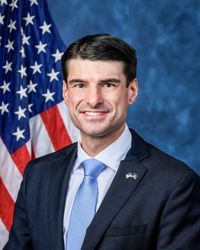
RBRobert Bresnahan
@robert_bresnahan
MM
NB
MA
CH
CJ"F
TC
RL
JC
YK
JM
GM
JP
GE
ES
EL"C
SD
DJ
ES
TK
JK
RB
CM
CT
RF
DB
JC
TW
JW
RB
BB
DR
RF
BF
AM
JM
RF
AH
TG
TM
BLThis resolution supports the designation of National Dairy Month.
This resolution encourages local communities throughout the United States to support nonprofit organizations that provide resources to Gold Shield Families during their time of need. Gold Shield Families consist of the families of fallen police officers, firefighters, emergency medical technicians, correction officers, emergency dispatch officers, and emergency service providers.
**AM Radio for Every Vehicle Act of 2025** This bill requires the Department of Transportation (DOT) to issue a rule requiring AM radio capabilities to be standard in all new passenger vehicles. (AM radio is often used to deliver emergency alerts and news and entertainment programming; some newer vehicles do not include AM equipment.) Specifically, this bill applies to passenger vehicles (1) manufactured in the United States for sale in the United States, imported into the United States, or shipped in interstate commerce; and (2) manufactured after the rule's effective date. The rule must require all such vehicles to have devices that can receive signals and play content transmitted by AM stations or digital audio AM stations installed as standard equipment and made easily accessible to drivers. Prior to the rule's effective date, manufacturers that do not include devices that can access AM radio as standard equipment (1) must inform purchasers of this fact through clear and conspicuous labeling, and (2) may not charge an additional or separate fee for AM radio access. DOT may assess civil penalties for any violation of the rule. The Department of Justice may also bring a civil action to enjoin a violation. The rule, including DOT’s authority to enforce it, must expire 10 years after the bill’s enactment. Further, the Government Accountability Office must study and report on the dissemination of emergency alerts to the public, including by conducting an assessment of AM radio relative to other Integrated Public Alert and Warning System communication technologies.
**Optimizing Research Progress Hope And New Cures Act or the ORPHAN Cures Act** This bill modifies certain provisions under the Medicare Drug Price Negotiation Program with respect to orphan drugs. The Medicare Drug Price Negotiation Program requires the Centers for Medicare & Medicaid Services to negotiate the prices of certain prescription drugs under Medicare beginning in 2026. Among other requirements, drugs must have had market approval for at least 7 years (for drug products) or 11 years (for biologics) to qualify for negotiation. The program does not apply to orphan drugs that are approved to treat only one rare disease or condition. The bill modifies these provisions so as to exclude any period in which a drug was an orphan drug from market approval calculations. It also excludes orphan drugs that are approved to treat more than one rare disease or condition from the program.
**Stop Chinese Fentanyl Act of 2025** This bill subjects certain Chinese entities and government officials to potential sanctions related to opioid trafficking and requires the President to conduct certain preliminary analyses before regulating economic transactions in the event of a national emergency related to international drug trafficking. Specifically, for the purposes of the Fentanyl Sanctions Act, the bill changes the definition of foreign opioid trafficker to specify that the term includes (1) Chinese entities involved in the production or sale of synthetic opioids or related pharmaceutical ingredients that fail to take steps to detect or prevent opioid trafficking; and (2) certain senior Chinese government officials that aid and abet opioid trafficking, including through intentional inaction. Under current law, the President must impose certain sanctions on individuals and entities identified as foreign opioid traffickers. Further, the bill extends through 2029 an existing requirement that the President report to Congress annually on identified foreign opioid traffickers and any sanctions imposed on them. (This requirement expired in December 2024.) The bill also requires the President to take additional steps in issuing regulations under the International Emergency Economic Powers Act (IEEPA) pursuant to a declared national emergency related to international drug trafficking. (IEEPA authorizes the President to regulate a variety of economic transactions following a declaration of national emergency.) Under the bill, the President must evaluate the costs and benefits of issuing economic regulations for the purpose of resolving the drug trafficking emergency and publish a discussion of such costs and benefits.
**Tim Hart Wildland Firefighter Classification and Pay Parity Act or Tim's Act** This bill increases compensation and establishes additional benefits and programs for federal wildland firefighters. (These individuals are employed by the Department of Agriculture, the Department of the Interior, or tribal governments.) The bill increases the minimum rate of basic pay for wildland firefighters at General Schedule (GS) levels 1 through 15 by percentages specified in the bill, with smaller increases for higher GS levels. The bill also requires comparable increases to the hourly rates paid to prevailing rate employees who are wildland firefighters. It also establishes premium pay for wildland firefighters who respond to certain prolonged fire incidents and are deployed outside of their normal duty stations or to an area adjacent to the incident. These changes take effect after other temporary pay increases for wildland firefighters expire. The bill also (1) establishes paid rest and recuperation leave; (2) allows certain prior service to be credited for retirement purposes; and (3) provides housing allowances, tuition assistance, and other benefits for wildland firefighters. Further, the bill directs the Office of Workers' Compensation Programs within the Department of Labor to ensure that psychological stress-related injuries and illnesses correlated to fire response are compensated and to expedite related claims. The bill also establishes programs to (1) assist the next-of-kin of wildland firefighters and fire support personnel who are critically injured or killed while in the line of duty, and (2) support the mental and physical health of wildland firefighters.