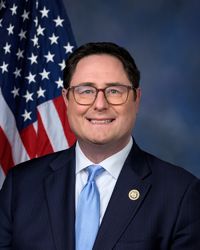
MFMike Flood
@mike_flood
This resolution supports the goals of National Catholic Schools Week, an event cosponsored by the National Catholic Educational Association and the U.S. Conference of Catholic Bishops and established to recognize the contributions of Catholic elementary and secondary schools in the United States.
This resolution ranks Representative Celeste Maloy of Utah immediately after Representative Dale Strong of Alabama on the Committee on Appropriations.
This resolution elects Members to the committees on Appropriations; Education and Workforce; Homeland Security; Rules; Small Business; and Transportation and Infrastructure.
**AM Radio for Every Vehicle Act of 2025** This bill requires the Department of Transportation (DOT) to issue a rule requiring AM radio capabilities to be standard in all new passenger vehicles. (AM radio is often used to deliver emergency alerts and news and entertainment programming; some newer vehicles do not include AM equipment.) Specifically, this bill applies to passenger vehicles (1) manufactured in the United States for sale in the United States, imported into the United States, or shipped in interstate commerce; and (2) manufactured after the rule's effective date. The rule must require all such vehicles to have devices that can receive signals and play content transmitted by AM stations or digital audio AM stations installed as standard equipment and made easily accessible to drivers. Prior to the rule's effective date, manufacturers that do not include devices that can access AM radio as standard equipment (1) must inform purchasers of this fact through clear and conspicuous labeling, and (2) may not charge an additional or separate fee for AM radio access. DOT may assess civil penalties for any violation of the rule. The Department of Justice may also bring a civil action to enjoin a violation. The rule, including DOT’s authority to enforce it, must expire 10 years after the bill’s enactment. Further, the Government Accountability Office must study and report on the dissemination of emergency alerts to the public, including by conducting an assessment of AM radio relative to other Integrated Public Alert and Warning System communication technologies.
**1071 Repeal to Protect Small Business Lending Act** This bill repeals the statute that requires financial institutions to collect data regarding applications for women-owned, minority-owned, or small business loans. Currently, financial institutions must collect and report to the Consumer Financial Protection Bureau information on (1) how many applications were received; (2) the disposition of each application; (3) the type of loan; (4) the amount applied for; (5) the amount approved; and (6) each applicant’s census tract, revenue, race, sex, and ethnicity.
**Regulation Decimation Act** This bill requires federal agencies to repeal certain existing rules prior to issuing a new rule. Specifically, the bill prohibits an agency from issuing a rule that imposes a cost or responsibility on a nongovernmental person or a state or local government unless it repeals ten or more related rules. Additionally, an agency may not issue a major rule that imposes such a cost or responsibility unless (1) the agency has repealed ten or more related rules, and (2) the cost of the new rule is less than or equal to the cost of the rules being repealed. A *major rule* is a rule that has resulted in or is likely to result in (1) an annual economic effect of at least $100 million; (2) a major increase in costs or prices for consumers, individual industries, government agencies, or geographic regions; or (3) significant adverse effects on competition, employment, investment, productivity, or innovation. Any such repealed rule must be published in the Federal Register. This bill does not apply to a rule or major rule that (1) relates to an internal agency policy or practice, (2) relates to procurement, or (3) is being revised to be less burdensome to decrease requirements imposed or compliance costs. Additionally, each federal agency must submit to Congress and the Office of Management and Budget a report that includes a review of each rule of the agency and that identifies whether each rule is costly, ineffective, duplicative, or outdated.