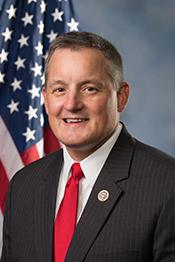
BWBruce Westerman
@bruce_westerman
This resolution provides amounts for the expenses of the House Committee on Natural Resources for the 119th Congress.
CS
BH
GB
MES
MM
RA
BW
RM
KS
AACR
AH
TK
AB
JVD
WH
GG
RF
TM
RF
EL"C
JRThis resolution supports the designation of National FFA (Future Farmers of America) Week. It also celebrates the 90th anniversary of New Farmers of America (NFA), which served Black vocational agriculture students in segregated public schools until NFA and FFA became one organization in 1965. The resolution also commemorates the 75th anniversary of the federal charter for the Future Farmers of America.
**Standardizing Permitting and Expediting Economic Development Act or the SPEED Act** This bill limits the scope of the National Environmental Policy Act of 1969 (NEPA) and modifies the environmental review of major federal actions under NEPA to generally limit the number of federal actions that trigger NEPA review and to expedite the review process. For example, the bill redefines *major federal actions*, including to specify that an agency may not determine that an action is a major federal action based solely on the provision of federal funds. It also excludes from the requirement for NEPA review certain proposed agency actions that have already been reviewed under another federal, state, or tribal environmental review statute that meets the requirements of NEPA. The bill directs an agency, when preparing an environmental document for a proposed agency action, to consider only those effects proximately caused by the immediate project or action under consideration. Agencies may not consider effects that are speculative, attenuated from the project or action, separate in time or place from the project or action, or in relation to separate projects or actions. The bill modifies the requirement for agencies to prepare an environmental assessment to apply to agency actions that are not likely to have a reasonably foreseeable significant effect on the quality of the human environment. (Currently, the requirement only applies to actions that do not have such an effect.) The bill makes a variety of other modifications to NEPA, including by limiting judicial review of NEPA cases.
**Fix Our Forests Act** This bill establishes requirements for managing forests on federal land, including requirements concerning reducing wildfire threats, expediting the review of certain forest management projects, and implementing forest management projects and other activities. Specifically, the bill (1) designates certain firesheds at high risk for wildfires as fireshed management areas; (2) directs the U.S. Forest Service and U.S. Geological Survey to jointly establish an interagency Fireshed Center that is responsible for duties related to assessing and predicting fire, including maintaining a fireshed registry on a publicly accessible website that provides interactive geospatial data on individual firesheds; and (3) makes other requirements related to reducing wildfire. Next, the bill expedites the review of certain forest management projects under the National Environmental Policy Act (NEPA) of 1969 and exempts certain activities from NEPA review. It also establishes intra-agency strike teams to accelerate the review and any interagency consultation processes under NEPA, the Endangered Species Act of 1973, and the National Historic Preservation Act. It also limits consultation requirements concerning threatened and endangered species under the Forest and Rangeland Renewable Resources Planning Act of 1974 and the Federal Land Management and Policy Act of 1976. Finally, it limits litigation involving fireshed management projects and limits remedies that courts may provide. Additionally, the bill supports reducing community wildfire risks, carrying out forest restoration and stewardship activities (including watershed protection and restoration), conducting biochar demonstration projects, advancing technologies to address forest wildfires, and assisting wildland firefighters and their families.
**Student Compensation and Opportunity through Rights and Endorsements Act or the SCORE Act** This bill provides a framework for the compensation of student athletes for the use of their name, image, or likeness (NIL). This includes addressing certain elements of the court approved agreement to settle the *In re College Athlete NIL Litigation* (i.e., *House* [settlement](https://www.congress.gov/crs-product/LSB11349)). Specifically, the bill statutorily prohibits institutions, conferences, or interstate intercollegiate athletic associations (e.g., the National Collegiate Athletic Association (NCAA)) from restricting the ability of a student athlete to enter an NIL agreement. The bill also requires institutions of higher education that generate $20 million or more in annual revenue from the institution's intercollegiate athletics activities to (1) provide counseling and medical benefits to student athletes, and (2) establish and maintain at least 16 varsity sports teams. Further, the bill authorizes interstate intercollegiate athletic associations to establish rules with respect to athletic eligibility, transfers, recruitment, and the disclosure of NIL agreements. Under the bill, student athletes may not be considered employees of an institution, conference, or interstate intercollegiate athletic association. The bill also preempts state laws with respect to compensation, payments, benefits, employment status, eligibility, and academic standards applicable to student athletes. Compliance with the provisions of this bill is considered lawful under federal and state antitrust laws.
**Pony Up Act** This bill requires the U.S. Postal Service (USPS) to pay a citizen for late payment fees or penalties incurred due to late delivery of mail by USPS. Late delivery of mail means that (1) USPS received a bill or notice of bill at least 12 days prior to the payment due date and delivered such bill or notice of bill less than 6 days prior to the payment due date; or (2) USPS received a payment at least 5 days prior to the payment due date and delivered such payment after the due date. USPS is not required to pay a citizen for late payment fees or penalties when a bill, notice of bill, or payment is delayed for reasons outside of USPS control (for example, if a major disaster or emergency declared by the President caused the delay).